
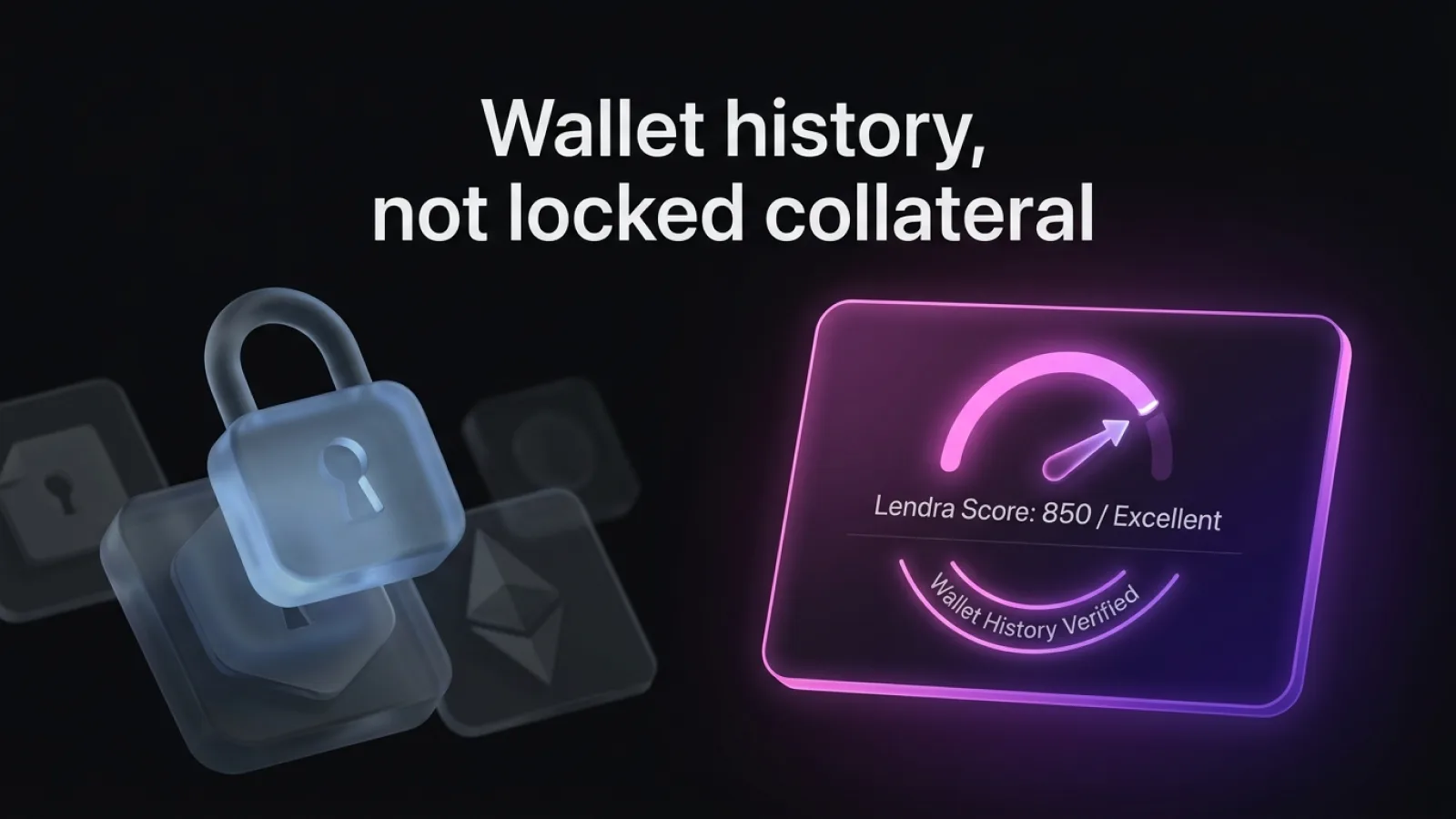
The money is already moving on-chain. The missing layer is credit.
Active crypto users can have years of wallet activity, stablecoin usage, and decentralized finance participation. Traditional banks do not recognize this wallet history. At the same time, most DeFi lending still requires overcollateralization.
This creates a frustrating gap. A user may have real on-chain behavior but still cannot borrow small amounts without depositing more than the loan amount first.
What This Means and Why It Matters
In traditional finance, lenders use credit scores to measure the risk of a borrower. Because decentralized finance operates on permissionless smart contracts, protocols do not have access to off-chain credit scores or legal identities.
To solve the issue of trust, DeFi protocols use code. They require borrowers to lock up excess capital to secure a loan. If you want to borrow $100 in USDC, you might have to deposit $150 worth of another cryptocurrency.
This matters because it excludes a massive segment of the market. Active crypto users in emerging markets often have financial behavior on-chain that traditional lenders ignore. These users need short-term liquidity but do not have excess capital to lock into a smart contract. Their wallet has history, but that history does not give them borrowing power.
How It Works
When you use a standard DeFi lending protocol, the process follows a strict set of rules:
You deposit a volatile asset into a smart contract.
The protocol calculates your maximum borrowing limit based on the value of your deposit.
You receive your loan in a stablecoin like USDC.
If the value of your deposited asset drops below a certain threshold, the smart contract automatically sells your collateral to repay the lenders.
This system is highly efficient for traders looking for leverage. It is completely ineffective for everyday users who need small emergency liquidity.
Example: Favour's Story
Favour is an active crypto user in Nigeria. She uses wallets, stablecoins, and DeFi.
One night, she needs urgent USDC. She tries the DeFi lending apps she already knows, but the answer is the same everywhere. To borrow $100, she needs to deposit more than $100 first.
Her wallet has activity. Her wallet has history. But that history does not help her. She is treated like a stranger despite her consistent on-chain financial behavior.
How Lendra Approaches It
Lendra exists to close that gap. The core insight is simple: wallets already contain financial behavior. They show activity, consistency, stablecoin usage, protocol interactions, and spending behavior.
Your wallet is your credit score.
Lendra turns active wallet history into a credit score, borrowing tier, and short-term USDC borrowing path. Instead of asking how much you can deposit, Lendra asks what your wallet has already proven.
Users connect a Solana wallet and Lendra scans their wallet activity using Solana RPC infrastructure. The product generates a Lendra Score out of 1000. From there, users can see their borrowing tier, understand their eligible amount, and simulate a short-term USDC loan.
Because the Lendra Credit Pool is currently in beta and simulation mode, users simulate a 7, 14, or 30-day term to see the fixed fee and the 30% bond. They then join the pool launch waitlist and connect Telegram alerts so Lendra can notify them when the pool goes live.
Benefits
Wallet history counts: Your past stablecoin usage and DeFi participation actively contribute to your Lendra Score.
Progressive credit: Credit should be progressive, not extractive. Lendra starts users with small limits like $10 or $25 and builds borrowing power over time.
Low transaction costs: Lendra is built on Solana. This makes small, wallet-native credit interactions fast and practical.
Clear next steps: Lendra AI explains credit scores and next actions in simple language so users know exactly how to improve their trust profile.
Risks or Limitations
Lendra is honest about its current limitations.
The Credit Pool is in beta: The live USDC credit pool is not active yet. Borrowing is currently simulation-based and waitlist-based to validate borrowing intent safely.
No guaranteed loans: Lendra does not promise instant large loans or guaranteed approvals. It promises a path to build borrowing power.
Pre-alpha privacy features: Users can strengthen their trust profile using Private Mode and Cross-Chain Credit. However, these are currently devnet and pre-alpha proof integrations. Lendra does not yet provide production mainnet privacy guarantees or full production cross-chain credit verification.
Final Takeaway
Active wallets have history, but no borrowing power. Overcollateralized lending works for trading, but it fails to provide accessible credit for everyday crypto users in emerging markets. The next credit layer for crypto will not start with bank statements or massive deposits. It will start with wallet behavior.
Scan your wallet to see your Lendra Score and borrowing power at lendra.finance.