
Introduction
The money is already moving on-chain. The missing layer is credit.
Active crypto users, especially in emerging markets like Nigeria and across West Africa, have real financial behavior recorded on the blockchain. They use Solana wallets, hold stablecoins, and participate in decentralized finance.
However, when these users need short-term liquidity, they hit a wall. Traditional banks do not recognize wallet history. At the same time, the crypto ecosystem has built infrastructure for trading and staking but has largely ignored accessible credit. If you have a rich history of on-chain transactions, you might expect that reputation to count for something. Currently, it rarely does.
What this means
The core DeFi lending problem is that most protocols are built for leverage, not for everyday liquidity.
To borrow $100 in USDC on a standard DeFi platform, you usually need to deposit $150 or more in another crypto asset first. This is known as overcollateralization. It protects the protocol from default, but it completely excludes users who simply need a small amount of short-term capital and do not have excess assets to lock up.
Why it matters
This structural gap means that credit remains inaccessible for the people who need it most. Crypto was designed to open up financial access, yet formal credit access remains limited in developing economies.
A user can have consistent stablecoin activity, diverse protocol interactions, and a long-standing wallet age. They have proven their financial reliability on-chain. But because lending protocols only ask "How much can you deposit?" instead of "What has your wallet already proven?", that rich history goes unused.
How it works
In the current DeFi system, borrowing works like a pawn shop. You hand over a valuable asset to get a smaller amount of cash.
Wallet-based credit flips this model. Instead of demanding upfront capital, it evaluates your past behavior. Wallets already contain financial data. They show activity, consistency, spending behavior, and protocol diversity. By analyzing these data points, it is possible to generate a credit profile. The better your history, the higher your borrowing power.
Example
Meet Favour, an active crypto user in Nigeria. She uses wallets, stablecoins, and DeFi regularly.
One night, she needs urgent USDC. She opens the DeFi lending apps she already knows, but the answer is the same everywhere. To borrow the amount she needs, she has to deposit more than the loan itself.
Favour has real wallet activity. Her wallet has history. But that history does not help her access the short-term liquidity she needs right now. She is treated like a stranger despite her proven on-chain behavior.
How Lendra approaches it
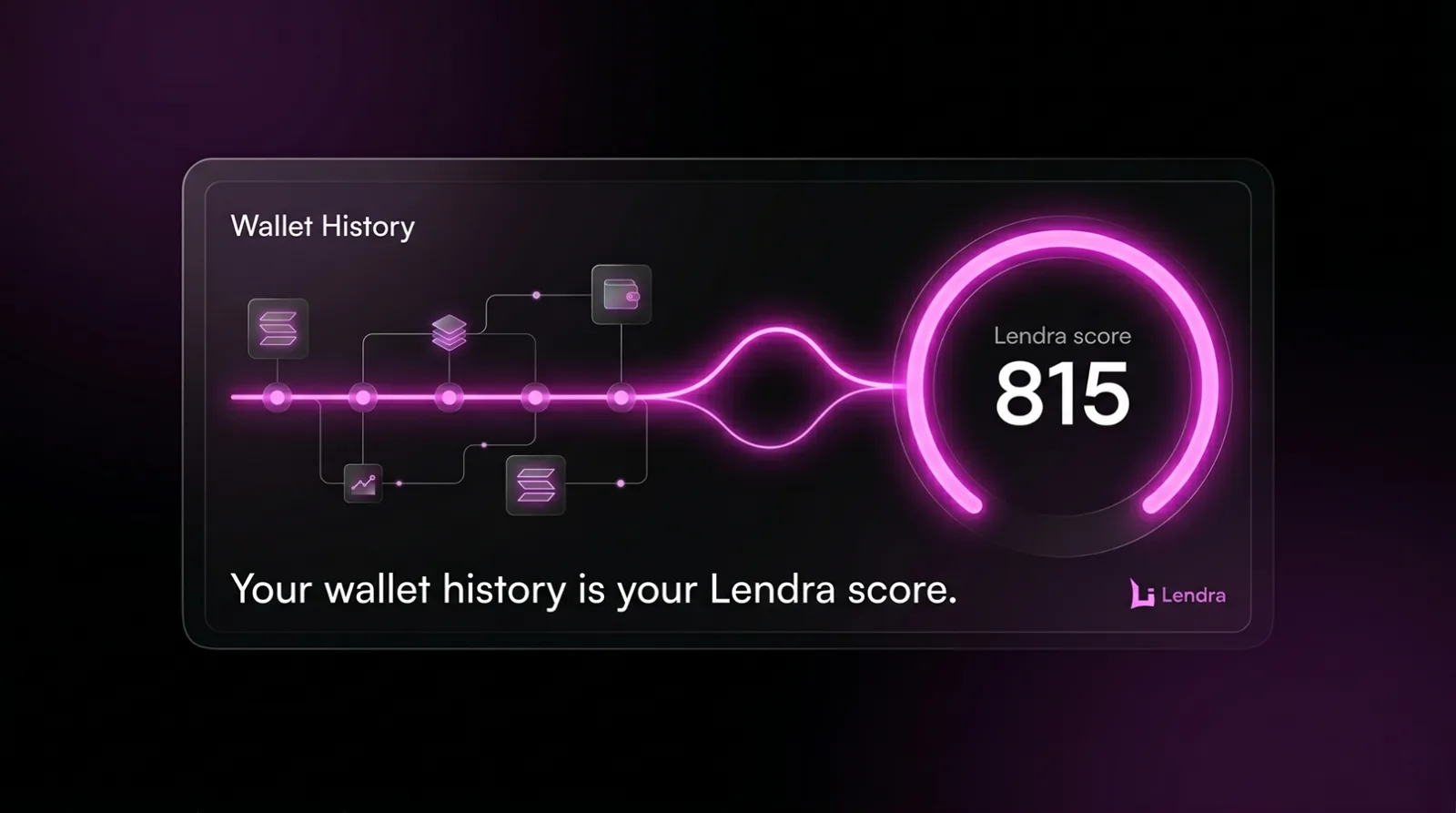
Lendra exists to close that gap. Lendra turns active wallet history into a credit score, borrowing tier, and short-term USDC borrowing path.
Your wallet is your credit score.
When users connect a Solana wallet to Lendra, the platform scans their wallet activity using Solana RPC infrastructure and generates a Lendra Score out of 1000. From there, users can see their borrowing tier and eligible amount.
Because the Lendra Credit Pool is currently in beta and simulation mode, users simulate a short-term USDC loan rather than taking a live loan. They can choose a 7, 14, or 30-day term, see the fixed fee, understand the 30% borrower commitment bond, and view their total repayment. After simulating, users join the pool launch waitlist and connect Telegram alerts so Lendra can notify them when the live pool is active.
Users can also strengthen their trust profile to unlock higher tiers. They can do this by connecting their X account for identity verification, enabling Private Mode, adding Cross-Chain Credit, and asking Lendra AI for guidance on how to improve their score.
Benefits
Wallet history counts: Your past stablecoin usage and Solana activity directly contribute to your borrowing power.
Progressive credit: Credit should be progressive, not extractive. Lendra is designed to let users start small, track repayment, and scale carefully.
Clear guidance: Lendra AI explains credit scores and next steps in simple language so users know exactly how to unlock the next level.
Low costs: Built on Solana, Lendra makes small, wallet-native credit interactions fast and practical.
Limitations
Lendra is honest about its current limitations. The product is a working beta MVP designed to validate borrowing intent before turning on live lending.
No guarantees: The Credit Pool is in beta and simulation mode. Lendra does not guarantee loans, approval, interest rates, or lender yield.
Privacy features are in pre-alpha: Private Mode and Cross-Chain Credit are currently devnet and pre-alpha proof integrations. Lendra does not yet provide production mainnet privacy guarantees or full production cross-chain credit verification.
Repayment data is pending: The next major milestone is a controlled live USDC credit pilot to prove that qualified wallet users repay.
Final takeaway
Active wallets have history, but no borrowing power. The current DeFi lending system works well for leverage but fails users who need practical, short-term liquidity. By turning on-chain behavior into credit reputation, wallet-based credit offers a new path forward. Your wallet has history. Now give it borrowing power.
Scan your wallet to see your Lendra Score and borrowing power at lendra.finance.